 Foreningen for blødere i Norge
Vær med å forme FBINs framtid
Foreningen 30. mai 26
The Norwegian Bleeding Disorder Society (FBIN) was established in 1966 as a nationwide organization.
FBIN’s mission is to provide guidance, information, and support to people with bleeding disorders and their families. The organization also works to increase public awareness and knowledge of bleeding disorders and to advocate for the interests of people with these conditions in dealings with government authorities and healthcare institutions. A key objective is to ensure the best possible treatment and care services for people with bleeding disorders throughout Norway.
FBIN is governed by a Board of Directors, while the day-to-day operations are managed by a part-time secretary. The organization’s highest governing body is the General Assembly, which is held every two years. Membership is open to anyone interested in bleeding disorders and in supporting the cause of people living with these conditions.
FBIN is a member of the Norwegian Federation of Organizations of Disabled People (FFO). Internationally, FBIN is affiliated with the World Federation of Hemophilia (WFH) and the European Hemophilia Consortium (EHC). The organization also maintains close cooperation with the other Nordic hemophilia associations.
The Norwegian Bleeding Disorder society’s purpose is to provide guidance, information, and support to people with bleeding disorders and their families.
History
The first hemophilia organization in the world was established in England around 1950. Other countries soon followed, and in 1963 a global federation of hemophilia organizations was formed. One of its key objectives was to encourage the establishment of new national hemophilia societies.
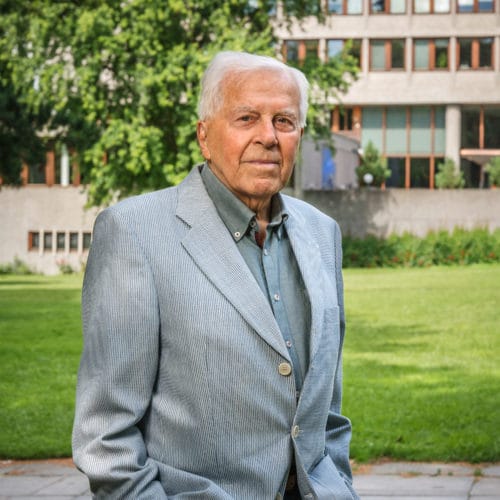
In Norway, Dr. Peter F. Hjort, who headed the Hematology Department at the National Hospital (Rikshospitalet), took the initiative to bring together a number of parents of children with hemophilia to form an association. The Norwegian Bleeding Disorder Society (FBIN) was officially founded on 24 September 1966, with Kjell Ulfsby serving as its first president.
Among the first issues addressed by the Association were the development of identification cards for people with hemophilia containing information on blood type and treatment methods, the publication of a handbook for people with hemophilia, and the establishment of outpatient clinics where treatment could be provided without hospital admission.
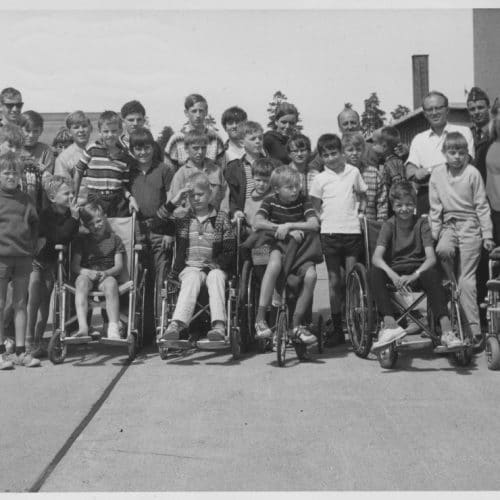
Several hemophilia associations abroad, including the Swedish Bleeding Disorder Society, had already begun organizing summer camps for children with hemophilia. The Norwegian Association adopted and further developed this idea. Under the leadership of social worker Esther Sanengen and Dr. Harald Grut, a camp model was created that combined much-needed recreation with a comprehensive assessment of participants’ overall situation. The work carried out during the camps was later followed up individually to help address each participant’s challenges. At the University of Oslo’s annual celebration in 1973, the two leaders were awarded Professor Skjelderup’s Gold Medal for their study based on the camp experience, entitled “Summer Camp for Persons with Disabilities – Luxury or Necessity?”
Helping people with hemophilia obtain appropriate education and vocational training has long been regarded as one of the Association’s most important tasks. With Esther Sanengen as the driving force, a “Home for Young People with Hemophilia” was established in 1969 to accommodate patients pursuing education and professional training.
In 1971, the Institute for Hemophiliacs (Institutt for blødere) was established. This later proved to be perhaps the most significant initiative ever undertaken by the Association. For practical reasons, the Institute was eventually separated from the Association and reorganized as an independent foundation governed by a board of nine members, four of whom were appointed by the Association. Through their own organization, Norwegian people with hemophilia thus maintained a decisive influence on the Institute’s long-term activities. The cooperation between the Bleeding Disorder Society and the Institute became a cornerstone of efforts to improve conditions for people with hemophilia in Norway.
The Institute for Hemophiliacs was a foundation that operated with financial support from the Norwegian government. It served as the hemophilia community’s own social medicine and competence center. In 2000, the Ministry of Health and Social Affairs initiated efforts to establish competence centers for all rare disease groups. At that time, the Institute for Hemophiliacs was one of only four such centers in Norway.
The Ministry decided that several additional rare disease groups should be incorporated into the center, making a name change necessary. On 1 January 2002, the center was renamed the Institute for Rare Disorders (ISD). Subsequently, it was merged with one of the other competence centers and is now known as the National Resource Centre for Rare Disorders (SSD).
The Foundation for Hemophiliacs owned a number of properties in the Vestli area of Oslo. The Norwegian Bleeding Disorder Society worked to safeguard these assets during negotiations with the government and succeeded in doing so. The foundation later changed its name and is now known as the Hemophilia Fund (Bløderfondet). The Fund is governed by a board consisting of five members and one deputy member.
Foreningen 30. mai 26
Foreningen 17. apr 26

Forskning 28. okt 25